
Steel grating for H-15 loads is a heavy-duty, vehicle-rated grating system designed for roadway openings, industrial traffic areas, bridge maintenance decks, culvert crossings, trench covers, loading zones, and similar applications. H-15 is not a simple pedestrian floor rating and it is not defined by one bar size, one mesh pattern, or one panel thickness. A proper H-15 grating design must consider the vehicle wheel load, impact allowance, bearing bar geometry, bar spacing, span, support frame, traffic direction, deflection limit, anchoring method, and project standard. Factory price is normally higher than ordinary walkway grating because H-15 applications require heavier steel sections, stronger banding, closer quality control, and often custom frames or anti-lift details.
H-15 is a legacy highway truck loading designation commonly associated with older AASHTO-style bridge and roadway design criteria. The “15” refers to a nominal 15 short-ton truck class, or approximately 30,000 lb of total vehicle weight in the traditional H-series concept. For heavy-duty grating selection, manufacturers commonly focus on the rear axle and wheel load because that is the critical load acting directly on the grating surface.
In a commonly used heavy-duty grating table convention, H-15 is evaluated from a 24,000 lb rear axle with dual wheels. When a 30% impact allowance is included, the design wheel load becomes approximately 15,600 lb, or about 69 kN, per wheel. This is substantially different from a normal pedestrian design load and explains why H-15 grating often has short support spans, deep bearing bars, reinforced edges, and carefully designed support frames.
| Load Category | Typical Legacy Axle Basis | Common Heavy-Duty Grating Wheel Load Basis | General Meaning |
|---|---|---|---|
| H-15 | 24,000 lb rear axle | About 15,600 lb per wheel with 30% impact | Heavy vehicle traffic for specified roadway or industrial applications |
| H-20 | 32,000 lb rear axle | About 20,800 lb per wheel with 30% impact | Higher vehicle loading than H-15 |
| H-25 | 40,000 lb rear axle | About 26,000 lb per wheel with 30% impact | More demanding heavy-truck loading condition |
| Pedestrian Floor Load | Usually a project-specific uniform and point load | Not normally based on vehicle wheel action | Walkways, platforms, stairs, and maintenance floors |
| Forklift Load | Depends on actual vehicle and axle data | Must use manufacturer axle loads, tires, and wheel contact area | Industrial traffic that cannot be assumed equal to H-15 |
A common mistake is to treat H-15 as a load per square meter. It is not. H-15 is a vehicle-related loading concept involving axle loads, wheels, tire contact areas, impact, and load distribution. A grating panel may carry a high uniform platform load but still be unsuitable for an H-15 wheel load concentrated over a small area.
For this reason, a quote described only as “H-15 grating” is incomplete. The buyer should confirm which design basis is required, whether the project follows a legacy H-15 truck model, a local roadway authority requirement, a current bridge loading rule, a specific wheel load, or another owner standard.
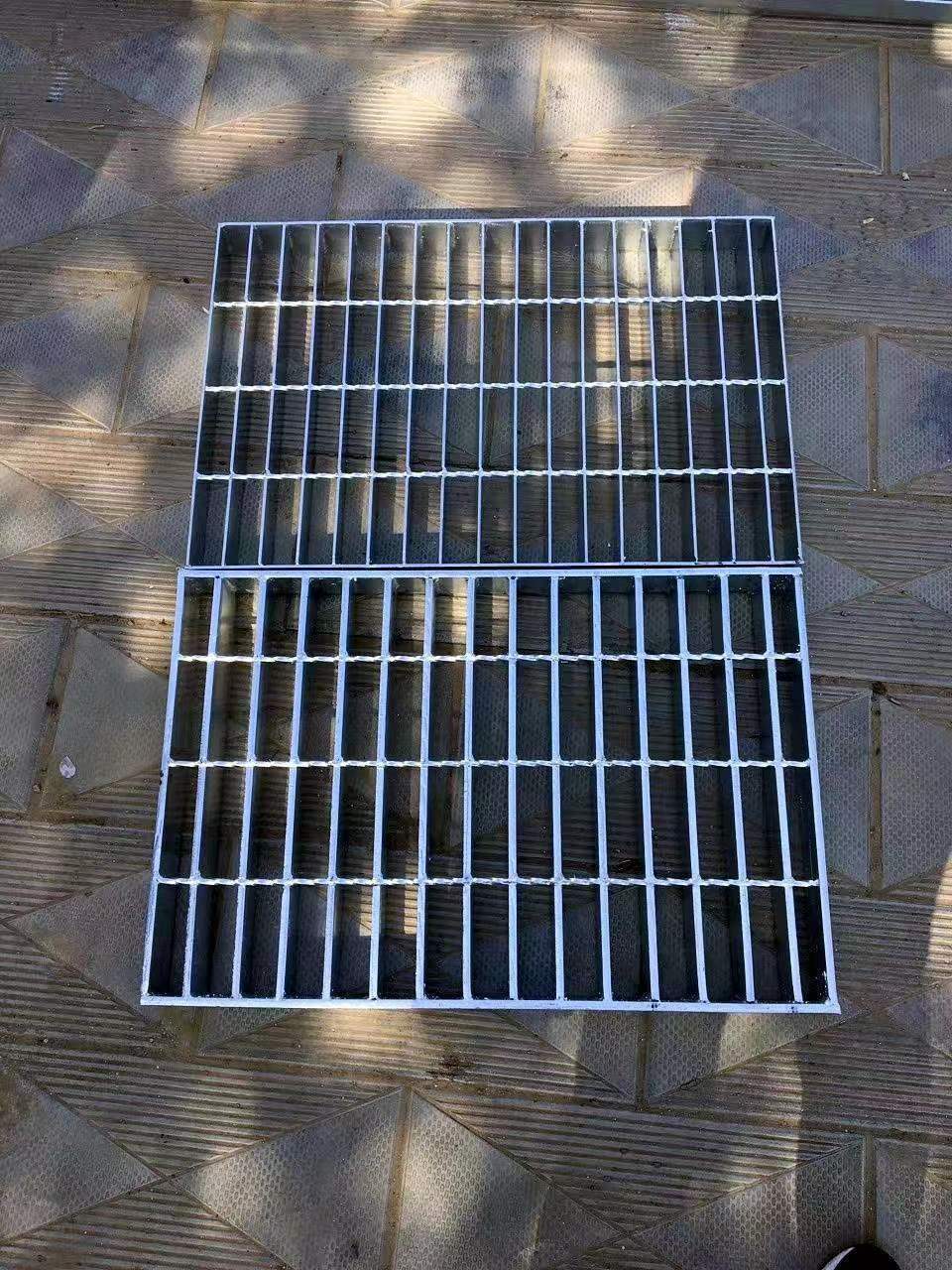
H-15 remains common on existing drawings, municipal specifications, bridge rehabilitation work, industrial facilities, and replacement projects. However, newer bridge or public-road projects may use different design frameworks, including current authority requirements, project-specific truck loads, lane loads, tandem loads, or modern bridge design standards.
Do not assume that H-15, H-20, HS-15, HS-20, HL-93, forklift traffic, and local highway authority requirements are interchangeable. A factory can manufacture the panel, but the responsible engineer or project authority should identify the governing load condition before production begins.
An H-15 traffic requirement is much more demanding than normal pedestrian grating. Pedestrian grating is usually selected from a uniform live load and a concentrated load for workers, tools, and ordinary maintenance equipment. H-15 grating must resist a much larger localized wheel action with an impact allowance and a defined distribution pattern.
| Application | Typical Load Concern | Why Ordinary Floor Grating May Not Be Suitable |
|---|---|---|
| Pedestrian Walkway | Workers, hand tools, maintenance traffic | Designed for distributed and limited point loads, not truck wheels |
| Industrial Platform | Workers, equipment, valves, pipe supports | May need concentrated-load checks but not necessarily wheel-load design |
| Pallet Jack Route | Small hard wheels and concentrated wheel contact | Small wheels can be severe even when total cart weight is modest |
| Forklift Route | Drive axle load, tire contact area, impact, repeated movement | Forklift capacity does not show actual wheel or axle loading |
| H-15 Roadway Grating | Heavy truck wheel load with impact and distribution criteria | Requires purpose-designed heavy-duty grating and supporting frame |
| H-20 or H-25 Traffic Grating | Higher rear axle and wheel loads than H-15 | May require larger bars, shorter spans, closer mesh, or stronger frame details |
H-20 and H-25 represent progressively heavier vehicle design conditions in traditional heavy-duty grating tables. The axle load and wheel load increase, so a panel that is suitable for H-15 may not be suitable for H-20 or H-25 without changing the bearing bar size, support spacing, grating type, or frame design.
For example, the common heavy-duty table basis increases from an approximately 15,600 lb H-15 design wheel load to approximately 20,800 lb for H-20 and 26,000 lb for H-25 when a 30% impact allowance is included. This difference is too large to ignore. Selecting H-15 when the site may receive heavier service vehicles can create expensive replacement work later.
Forklift traffic must be evaluated separately. A forklift rated to lift 3 tons, 5 tons, or another capacity may place a high percentage of its gross weight on one axle, particularly when it is carrying a load. Tire type, wheelbase, wheel spacing, tire width, tire pressure, turning movement, braking, speed, and travel direction all affect the grating design.
A forklift is not automatically lighter or safer than an H-15 truck simply because its total vehicle weight is lower. Hard tires, narrow wheels, repeated routes, and braking loads can create severe local stress. The factory should receive the forklift manufacturer’s maximum front and rear axle loads, tire dimensions, and travel pattern rather than only the rated lifting capacity.
Upgrade the design review when the location may receive heavier municipal vehicles, emergency vehicles, refuse trucks, delivery trucks, loaded forklifts, high-frequency traffic, high-speed traffic, or multi-directional turning movement. H-15 may be adequate for a controlled service road but inadequate for an access route that can later be used by heavier trucks.
For public infrastructure, bridge decks, roadway crossings, airport service areas, or critical industrial access, the final load class should be approved by the responsible engineer or authority before the grating manufacturer prepares final drawings.
Vehicle grating is not designed by placing the total truck weight on one panel. The critical action is the wheel load applied through a defined tire contact area and distributed over nearby bearing bars. The grating must also account for impact caused by moving vehicles, braking, uneven surfaces, joints, vibration, and repeated traffic.
A 15-ton vehicle does not place all of its weight on one wheel. The vehicle load is shared between axles and wheels, but the rear axle and drive wheels can still create a very high local load. Heavy-duty grating tables often begin with the axle load, divide it between the wheels, and then add an impact factor to create a design wheel load.
For a typical H-15 grating table convention:
This does not mean every project uses exactly the same impact factor or distribution pattern. It means the approved load table must match the project requirement. The buyer should not combine numbers from different manuals, vehicle categories, or standards without engineering review.
A tire footprint is distributed across several bearing bars, not just one. The number of bars involved depends on the bearing bar pitch, the tire contact area, the wheel position, and the direction of travel relative to the bearing bars. Closer bearing bar spacing can help distribute a wheel load across more bars, but it also increases steel weight and reduces open area.
| Factor | Effect on H-15 Grating Design |
|---|---|
| Wheel Contact Width | A wider tire spreads the load over more bearing bars than a narrow tire. |
| Bearing Bar Pitch | Closer bars can place more bearing bars beneath the tire footprint. |
| Wheel Position | A wheel near midspan is often more critical than one directly over a support. |
| Traffic Direction | Changes the way the tire crosses bars, joints, and panel edges. |
| Cross Bar Pitch | Affects local surface support, panel stability, and opening size. |
| Impact | Increases design action from movement, joints, speed, and uneven surfaces. |
| Repeated Traffic | Can require attention to fatigue, welds, banding, clips, and support details. |
Hard polyurethane, nylon, steel, or narrow solid wheels can create a more severe localized effect than pneumatic tires. A small caster may fall into an opening, strike a cross bar, or repeatedly load the same bearing bars. This is why a grating that works for truck tires may still need a separate evaluation for forklift, pallet jack, trolley, or equipment-caster traffic.
If hard wheels are expected, provide the wheel diameter, tread width, material, maximum wheel load, route, speed, and whether the wheel crosses panel joints. In some cases, a close-mesh grating, plate cover, alternate wheel path, or different flooring system may be more appropriate than open bar grating.
Bearing bars are the main structural members of steel grating. They span from one support to another and carry most of the wheel-induced bending load. For H-15 applications, the required bar depth and thickness depend on span, bar pitch, construction method, wheel distribution, deflection limit, and support condition.
A bar described as 50 x 5 mm is approximately 50 mm deep and 5 mm thick. The bar depth has a major effect on stiffness over the span, while thickness increases steel area and local strength. Neither dimension can be selected independently.
| Illustrative Bearing Bar Family | Typical H-15 Design Discussion | Important Note |
|---|---|---|
| 40 x 5 mm or 40 x 6 mm | May be considered for very short, well-supported vehicle openings | Not a universal H-15 solution; verify against the exact table and frame layout |
| 50 x 5 mm or 50 x 6 mm | Common starting family for heavier industrial and short-span traffic grating | Capacity changes greatly with bar pitch and span |
| 60 x 6 mm or 60 x 8 mm | Used where more stiffness, deeper section, or a larger load reserve is required | Panel weight and support-seat depth increase significantly |
| 75 x 8 mm and above | Often considered for demanding spans, roadway covers, or custom heavy-duty structures | Normally requires project-specific design and mechanical handling |
A deeper bearing bar generally improves bending stiffness more effectively than simply adding a small amount of thickness. This is why a 60 x 6 mm bearing bar can perform very differently from a 40 x 6 mm bearing bar over the same clear span. However, deeper bars also increase the panel depth, frame size, installation weight, galvanizing cost, and available clearance beneath the grating.
Thickness adds steel to every bearing bar across the panel. For example, changing a 50 x 5 mm bar to a 50 x 6 mm bar increases the bar area by 20%. On a close-spaced heavy-duty panel, this can add a substantial amount of steel per square meter before cross bars, banding, frames, and galvanizing are included.
For vehicle grating, buyers should avoid choosing a bar only because it looks heavy. The correct bar should be selected from the approved load table or calculation. An oversized bar can increase cost unnecessarily, while an undersized bar can create excessive deflection, fatigue, damage to the frame, or unsafe wheel movement.
Heavy-duty H-15 grating commonly spans much shorter distances than ordinary walkway grating. The finished panel may be 1,000 mm, 1,500 mm, or 3,000 mm long, but it can rest on intermediate supports so that the actual clear span is only a few hundred millimeters.
Do not confuse panel length with clear span. A 3,000 mm long panel is not automatically designed to span 3,000 mm under H-15 traffic. The shop drawing must show the support lines and bearing bar direction clearly.
For general terminology and dimension references, see this steel bar grating dimensions guide.
Heavy-duty roadway grating needs a mesh pattern that balances wheel-load distribution, drainage, debris clearance, heel safety, tire contact, and steel consumption. A larger opening improves water flow but may reduce small-object retention and create a less comfortable surface for narrow wheels. A closer mesh increases bar count, panel weight, and cost.
| Mesh Pattern | Approximate Meaning | Common Design Consideration |
|---|---|---|
| 30 x 100 mm | 30 mm bearing bar pitch and 100 mm cross bar pitch | General industrial and drainage grating where vehicle design is verified by bar size and span |
| 30 x 50 mm | 30 mm bearing bar pitch and 50 mm cross bar pitch | Smaller longitudinal openings and more frequent cross bar support |
| 19W4 | About 30.2 mm bearing bar pitch and 101.6 mm cross bar pitch | Common inch-based welded grating pattern for industrial and heavy-duty layouts |
| 19W2 | About 30.2 mm bearing bar pitch and 50.8 mm cross bar pitch | Closer cross bar spacing for industrial floor and wheel-related applications |
| W-15 or Close-Mesh Heavy Duty | Closer bearing bar spacing than W-19-type layouts | Can improve wheel distribution and opening control but uses more steel |
For H-15 traffic, bearing bar pitch affects how many bars are available beneath the wheel footprint. Closer spacing can improve load sharing and reduce the risk of narrow tires or objects entering an opening. It also increases the number of bearing bars per meter, making the panel heavier and more expensive.
Mesh spacing alone does not define vehicle capacity. A 30 x 100 mm grating with 30 x 3 mm bearing bars is not comparable to a 30 x 100 mm grating with 60 x 6 mm bearing bars. Both have the same visible mesh, but their load capacity and weight are dramatically different.
Welded heavy-duty grating may use twisted square cross bars, round cross bars, or other transverse members. Riveted grating commonly uses formed or reticulated bars connected by rivets. Cross bars stabilize the panel and influence local surface behavior, but the bearing bars remain the main span members.
For high-speed, heavy, or multi-directional traffic, load-carrying banding and reinforced edge details may be more important than changing the cross bar profile alone. The whole panel, including its perimeter and frame, must act as a system.
The bearing bar direction is one of the most important details in H-15 grating. Bearing bars must span between supports. If a panel is installed with the bars in the wrong direction, the actual span may be much longer than designed, causing severe deflection or failure under vehicle loads.
| Term | Meaning | Importance for H-15 Grating |
|---|---|---|
| Clear Span | Unsupported distance between bearing supports | Primary dimension used to select bearing bar size from a load table |
| Panel Length | Overall finished dimension of the grating panel | May be much longer than the actual structural span |
| Bearing Bar Direction | Direction in which bearing bars run and span between supports | Must be shown on drawings and maintained during installation |
| Support Width | Actual seating length beneath each bearing-bar end | Insufficient seating can damage edges or allow displacement |
| Traffic Direction | Direction vehicle wheels move over the panel | Affects wheel crossing behavior, joints, braking, and distribution assumptions |
For a rectangular opening, the supports may be beams, channels, angles, concrete ledges, structural frames, or fabricated curb angles. The bearing bars should run perpendicular to the supports so that they span directly from one support to the other.
On a square panel, bearing direction is easy to overlook because both outside dimensions are the same. The panel should be marked during fabrication and installation so that the site team cannot rotate it incorrectly.
Vehicle travel direction is not the same as bearing bar direction, although the two are closely related in heavy-duty design. The engineer or manufacturer needs to know whether traffic crosses the bearing bars, runs parallel to them, turns over the grating, brakes at the opening, or travels in more than one direction.
Heavy, high-speed, or multi-directional traffic can introduce additional impact and fatigue concerns. In these cases, the design may require load-carrying banding, reinforced panel ends, improved anchoring, thicker frames, or a different grating type.
The grating must have enough bearing seat on the supporting frame. A heavy-duty panel should not rest on a narrow edge that can bend, chip, or allow the bearing bars to slip. Some heavy-duty manufacturer catalogues use approximately 25 mm minimum bearing for moderate-depth bars and approximately 50 mm for deeper bar sections, but the required support seat must follow the approved load design and manufacturer details.
Support frames also need to be checked for bending, torsion, anchorage, and concrete breakout where applicable. A strong grating panel cannot compensate for an undersized or poorly anchored frame.
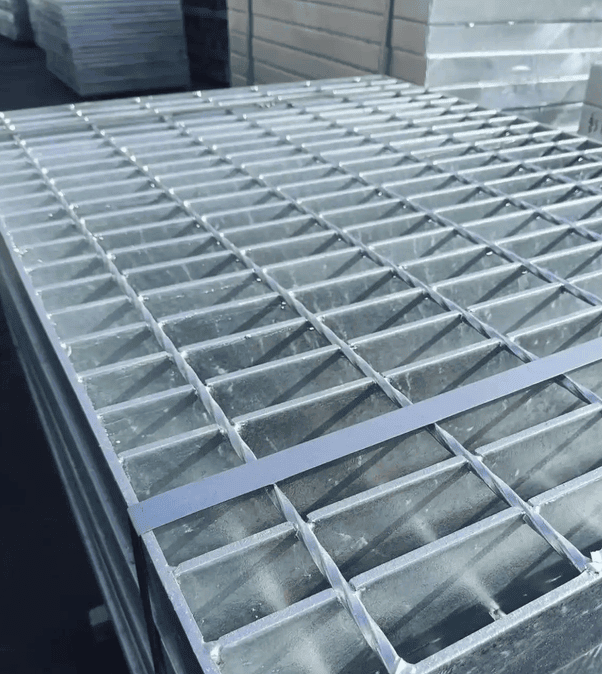
H-15 grating must be checked for both strength and deflection. Strength verifies that the bearing bars, cross bars, welds, rivets, banding, and support frame can resist the applied load. Deflection verifies that the panel does not move excessively under the design wheel load.
Excessive deflection can create a noticeable bounce, loosen clips, crack nearby concrete, damage coatings, create tire impact at panel joints, trap debris, or reduce vehicle control. For drainage grates and roadway panels, excess movement can also generate noise, rattling, or progressive damage to the support frame.
Heavy-duty grating manuals often use strict deflection criteria for vehicle traffic, such as a fixed maximum movement or a span-related limit. The exact acceptable deflection must come from the project requirement, the governing design standard, or the relevant manufacturer load table. Do not apply a pedestrian deflection limit to roadway traffic without checking the intended design basis.
| Verification Method | When It Is Useful | What Must Match the Actual Project |
|---|---|---|
| Manufacturer Load Table | Standard welded or riveted grating with known span and vehicle class | Bar size, mesh, material, construction type, span, support, wheel condition |
| Project-Specific Calculation | Custom panels, unusual frames, long spans, nonstandard wheel loads | All geometry, support stiffness, vehicle data, deflection criteria, load path |
| Prototype Load Test | Special infrastructure, unique fabrication, owner-required validation | Test support arrangement, load position, acceptance criteria, measurement method |
| Authority Review | Public roads, bridges, municipal drainage, regulated infrastructure | Adopted standard, local code, submittal requirements, engineer approval |
A load table prepared for a particular welded carbon steel series may not apply to a press-locked panel, stainless steel panel, serrated version, different bar pitch, or custom frame. Likewise, a table for H-20 cannot be reduced informally to create an H-15 approval without confirming the manufacturer calculation method.
Use the exact load table or engineering method for the grating type being supplied. For heavy-duty product selection, this heavy-duty steel grating specification guide can help identify the information a factory needs before quoting.
Welded and riveted grating are both used for vehicle-related applications, but they are not identical systems. The correct selection depends on load magnitude, span, traffic direction, repeated loading, project standard, open-area requirement, panel layout, and budget.
| Grating Type | Construction | Typical Strengths | Typical Cost Position |
|---|---|---|---|
| Heavy-Duty Welded Grating | Cross bars resistance welded to bearing bars | Rigid industrial construction, efficient production, broad size range | Usually lower than riveted for similar steel weight |
| Heavy-Duty Riveted Grating | Reticulated bars and mechanical rivets connect bearing bars | Suitable for certain repeated rolling-load and bridge deck applications | Often higher due to added components and labor |
| Press-Locked Grating | Slotted bars mechanically pressed together | Flush appearance and flexible mesh options | Usually selected for pedestrian, architectural, or specialized layouts; vehicle use needs exact verification |
Welded grating is widely used for truck-rated trench covers, drainage covers, loading dock floors, industrial roadways, and utility access panels. It can be manufactured with deep bearing bars, thick steel, close bar spacing, load-carrying banding, and custom frames.
For H-15 applications, weld consistency, edge banding, frame seating, and support design are critical. The grating should be selected from a vehicle load table that matches the welded construction, not from a standard pedestrian grating chart.
Riveted grating is often selected for bridge decks, roadway-style surfaces, ramps, and applications involving repetitive rolling loads. Its mechanical connection pattern can perform well under traffic when designed as a complete system. Riveted grating may have a higher factory price because it uses formed transverse members, rivets, more processing steps, and often heavier bar configurations.
It should not be assumed that riveted grating is always stronger than welded grating. Both systems have different load tables and construction details. The correct choice depends on the actual vehicle load, span, traffic pattern, and owner specification.
Surface selection affects worker traction, tire behavior, cleaning, drainage, snow accumulation, and debris shedding. Heavy-duty grating can be supplied with smooth bearing bars or serrated bearing bars.
| Surface Type | Advantages | Potential Limitations |
|---|---|---|
| Smooth Bearing Bars | More uniform tire contact, easier cleaning, simpler debris removal | May provide less traction for footwear in wet, oily, or icy conditions |
| Serrated Bearing Bars | Improved traction for workers in rain, oil, snow, sludge, and wet industrial areas | Can retain debris and should be checked for tire, cleaning, and load-table suitability |
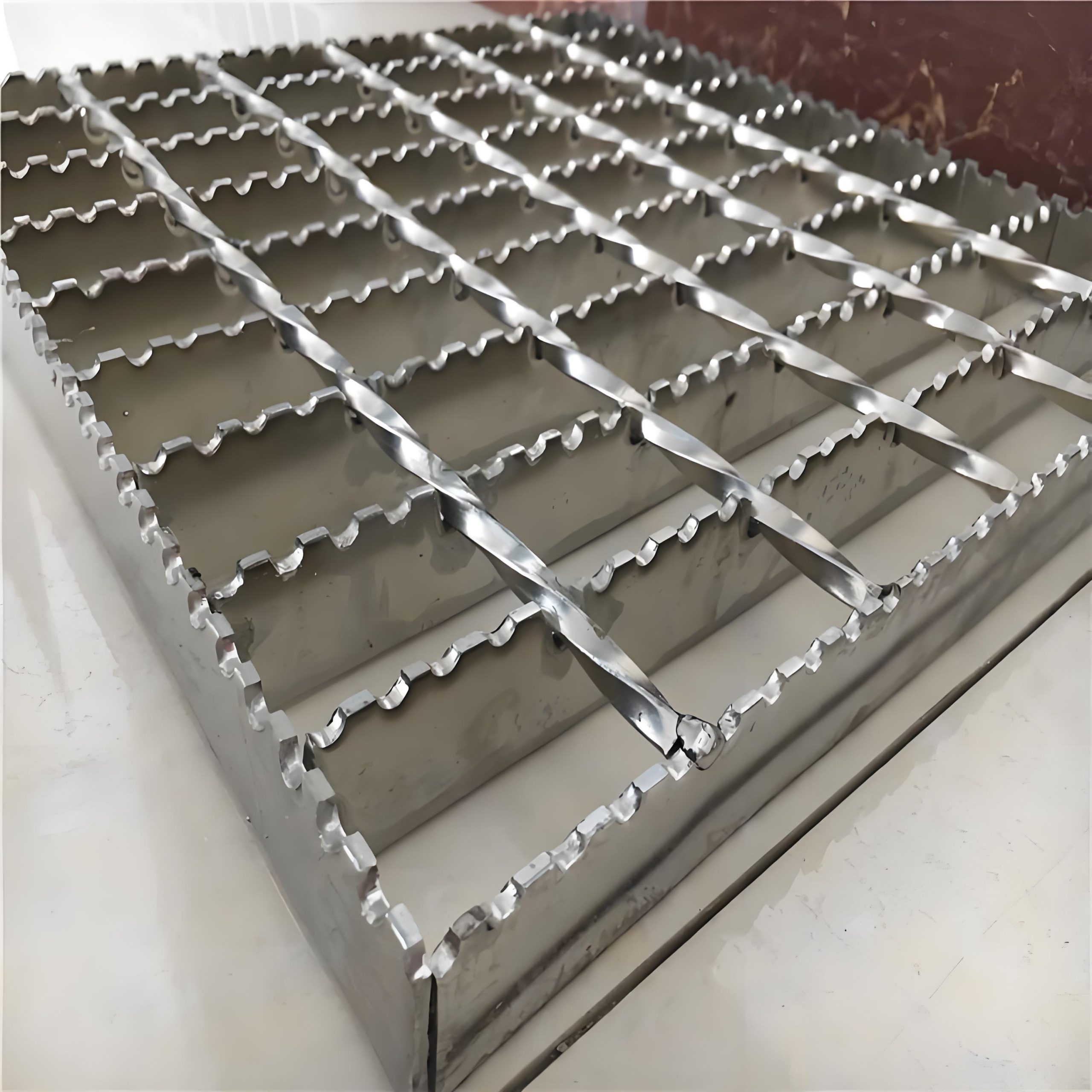
Serrated bearing bars are commonly selected for bridge maintenance decks, outdoor platforms, wastewater facilities, ramps, marine structures, snow-prone areas, and wet industrial access routes. The teeth improve grip for boots and work shoes when water, ice, oil, or sludge is present.
Serration does not eliminate the need for drainage, cleaning, handrails, lighting, and safe panel fixation. In areas where snow, mud, leaves, or oily debris can build up, a maintenance plan remains necessary.
For vehicle traffic, surface selection should be reviewed with the tire type and travel conditions. A serrated surface may be beneficial for worker traction, but smooth top bars can be easier to clean and may offer more uniform tire contact in certain applications. The correct choice depends on tire material, wheel load, speed, route, slope, weather exposure, and debris conditions.
Do not treat serrated bar grating as a substitute for a dedicated anti-skid roadway deck where high-speed, public-road, or severe weather traffic is involved. The roadway authority or engineer should determine whether open grating is appropriate for the route.
An H-15 grating panel is only as reliable as the frame that supports it. The support frame must transfer wheel loads into the surrounding concrete, steel structure, trench walls, culvert edges, or bridge deck without bending excessively, cracking, shifting, or allowing the grating to lift.
Frames may be fabricated from angles, channels, flat bars, structural sections, cast components, or reinforced concrete ledges. The support face must be level, continuous, and strong enough to carry the bearing-bar reactions. Uneven supports can create rocking panels, concentrated loads, noise, and early coating damage.
| Frame Detail | Purpose | Why It Matters for H-15 Service |
|---|---|---|
| Continuous Bearing Ledge | Supports the bearing-bar ends along the intended frame line | Prevents unsupported edges and uneven wheel reactions |
| Load-Carrying Frame | Transfers wheel load to concrete or structural steel | Must be engineered with the grating, not selected after panel fabrication |
| Anchor Bolts or Welded Connections | Secure the frame against movement and uplift | Reduces rattle, theft, traffic-induced movement, and frame displacement |
| Anti-Lift Device | Restrains removable panels from lifting under traffic, vibration, or pressure | Important for roadway covers, drainage grates, and public-access openings |
| Recessed Fastener | Keeps bolts below or flush with the traffic surface | Protects fasteners and reduces tire impact or trip hazards |
| Lift Hole or Lifting Key | Allows maintenance access without damaging the panel | Should be designed to avoid weakening critical bearing bars |
Traffic vibration can cause grating panels to move if they are not restrained. Anti-lift clips, bolted hold-downs, locking bars, recessed bolts, captive fasteners, hinges, or frame locks may be used depending on whether the panel needs to be removable.
For public areas and roadside drainage, anti-theft details may also be required. A loose or missing vehicle-rated cover is a major safety hazard, so the locking system should be matched to the maintenance method and access frequency.
A low panel price can be misleading if it excludes the frame, anchors, holding clips, lifting hardware, reinforcement, or galvanizing repair. For H-15 trench covers and roadway openings, request a complete assembly price or clearly separate the grating panel and frame scope.
Material selection influences initial cost, corrosion resistance, maintenance requirements, finish, and service life. Carbon steel is common for vehicle-rated grating, while hot-dip galvanizing is widely used for outdoor corrosion protection. Stainless steel is selected where chloride exposure, food hygiene, chemical service, or long-term appearance justify a higher price.
| Material Option | Typical H-15 Application | Main Benefit | Relative Factory Cost |
|---|---|---|---|
| Bare Carbon Steel | Dry indoor industrial traffic areas | Lowest initial cost and easy fabrication | Lowest |
| Painted Carbon Steel | Indoor plant floors and protected equipment areas | Color identification and moderate corrosion protection | Low to moderate |
| Hot-Dip Galvanized Carbon Steel | Outdoor trench covers, drainage systems, utility roads, wet industrial areas | Durable zinc coating for general atmospheric corrosion resistance | Moderate |
| 304 Stainless Steel | Food, washdown, architectural, and moderate corrosion environments | Clean appearance and corrosion resistance without galvanizing | High |
| 316 or 316L Stainless Steel | Marine, coastal, chemical, wastewater, and chloride-rich service | Improved corrosion resistance in demanding environments | Very high |
Carbon steel is usually the most practical material for heavy-duty roadway grating because it is strong, widely available, easy to weld, and comparatively economical. The correct steel grade should follow the project specification and load-table basis. Bare carbon steel is suitable only where corrosion is controlled and maintenance is practical.
Hot-dip galvanized carbon steel is a common choice for outdoor vehicle grating, drainage covers, culvert crossings, bridge access decks, utility facilities, and wet industrial locations. The zinc coating provides practical corrosion protection, but the design should still avoid water traps, poorly drained frames, and damaged edges.
Cutting, welding, drilling, and custom fabrication should normally be completed before galvanizing whenever possible. A detailed hot-dip galvanized steel grating guide can help buyers understand coating and fabrication considerations.
Stainless steel may be used for H-15 grating where corrosion exposure is severe, such as coastal wastewater plants, chemical drainage systems, marine facilities, food plants, and chloride-rich washdown areas. The steel grade does not automatically make the grating heavy duty; the bearing bars and frame still need to meet the vehicle load requirement.
304 is used in moderate corrosion environments. 316 or 316L is often selected for chloride exposure, marine air, saltwater splash, chemical washdown, and aggressive wet service. Material selection should consider the actual chemical medium, concentration, temperature, cleaning routine, and possibility of trapped deposits.
H-15 steel grating is typically used where controlled vehicle access crosses an opening. The application determines whether open bar grating is appropriate, what frame is needed, how the surface should be finished, and whether a welded or riveted system is preferred.
| Application | Typical H-15 Design Concerns |
|---|---|
| Bridge Maintenance Deck | Traffic direction, repetitive wheel loading, drainage, anti-slip surface, panel anchoring, fatigue |
| Culvert Crossing | Frame support, water flow, debris, concrete interface, anti-lift details, wheel impact |
| Trench Cover | Clear opening, bearing ledge, drain capacity, removable access, load path into channel walls |
| Loading Dock Floor | Forklift wheels, turning action, dock traffic, pallet jacks, joint protection, coating durability |
| Industrial Service Road | Vehicle classification, traffic frequency, snow, mud, drainage, frame anchoring, replacement access |
| Stormwater Inlet | Open area, debris retention, hydraulic flow, public safety, anti-theft fastening, maintenance access |
Open grating can be used on bridge maintenance routes, access decks, and specialty bridge structures where drainage and reduced dead load are important. The final selection must consider traffic type, vibration, fatigue, weather exposure, snow and ice, railing systems, and the governing bridge authority requirements.
For public bridge traffic, the authority may require a load model more demanding than H-15. The grating manufacturer should receive the approved design documents rather than relying on a brief verbal description of the traffic.
H-15 grating can cover culvert openings and large drainage channels where service vehicles must cross. The opening dimensions, support ledges, frame section, concrete strength, channel wall details, hydraulic flow, debris conditions, and lifting access all need to be considered.
A cover that has enough bar strength but insufficient frame support can fail at the edges. The frame and surrounding civil structure should be designed to carry the wheel reaction into the concrete or steel support system.
Industrial trench covers may need to carry forklifts, service trucks, maintenance vehicles, or loaded carts. The grating should be selected for the actual equipment route, not merely the largest vehicle that might pass nearby. If forklifts turn or stop on the cover, the frame and anchoring details may need additional attention.
Factories can produce standard heavy-duty grating blanks, but most H-15 projects need made-to-order panels. Roadway openings vary in width, support spacing, frame geometry, drainage requirements, access locations, and installation conditions.
| Panel Type | Typical Use | Fabrication Consideration |
|---|---|---|
| Rectangular Standard Panel | Simple trench covers and repeated industrial openings | Lowest fabrication cost when dimensions match efficient production layouts |
| Long Narrow Strip Panel | Drainage channels, curbs, and linear trench systems | Requires continuous support and joint alignment control |
| Framed Removable Cover | Valve chambers, pits, culverts, and equipment access openings | Frame, lifting, anti-lift, and handling details must be included |
| Curved or Radius Panel | Round drains, curved channels, and architectural roadway areas | Higher cutting, banding, and fitting cost |
| Panel with Cutouts | Pipes, bollards, posts, valves, and utility penetrations | Interrupted bearing bars may require reinforcement and banding |
| Hinged or Locking Cover | Frequent access, public areas, anti-theft locations | Hinges and locks must not reduce the structural support path |
Using repeated panel widths and standard raw-material lengths can reduce waste and factory cost. However, a low number of very large panels may create lifting and maintenance problems. H-15 panels can be heavy, especially when they include thick bearing bars, close mesh, banding, frames, and galvanizing.
For removable covers, consider the maximum safe lifting weight. A panel that requires a crane may be acceptable for an annual maintenance opening but impractical for an access cover that must be opened weekly.
Pipe holes, column notches, lifting points, drain outlets, bollard penetrations, and frame transitions can interrupt bearing bars. The manufacturer may need to add banding, trimming bars, angles, support plates, or reinforced edges. A cutout should be shown with exact dimensions and center locations on the shop drawing.
Field cutting after galvanizing should be avoided where possible because it can remove protective coating, create sharp edges, alter load paths, and invalidate the approved fabrication design.
H-15 grating must carry vehicle loads while still allowing water through the opening. The correct open area depends on drainage flow, debris size, tire safety, small-object retention, cleaning access, and the purpose of the opening.
A larger opening improves water flow, ventilation, and light transmission. It can be useful for bridge decks, stormwater channels, drainage systems, and wet industrial platforms. However, wider openings can increase the chance of debris entering the channel, small objects falling through, or narrow wheels interacting poorly with the grating.
Closer mesh can improve small-wheel performance, reduce clear opening size, and distribute loads across more bearing bars. It also increases steel weight, cost, and potential debris retention. In dirty drainage environments, a close mesh may clog more easily and require more frequent cleaning.
Water capacity depends on the grating open area, channel slope, outlet size, debris, sediment, upstream catchment, rainfall intensity, and maintenance program. A grating supplier can provide opening information, but the drainage system should be designed by the responsible civil or drainage engineer.
Heavy-duty H-15 grating requires controlled fabrication because vehicle-rated panels depend on accurate bar geometry, weld quality, edge banding, frame fit, and support seating. A small error in bearing bar direction or support dimension can create a major installation problem.
| Inspection Item | Why It Matters |
|---|---|
| Bearing Bar Height and Thickness | Confirms the structural section matches the approved load design. |
| Bearing Bar Pitch | Controls load distribution, opening size, panel weight, and mesh compliance. |
| Cross Bar Pitch | Controls opening pattern, local stability, and wheel surface behavior. |
| Bearing Bar Direction | Prevents incorrect installation and unintended long span. |
| Load-Carrying Banding | Helps transfer edge loads and supports heavy traffic conditions. |
| Frame Dimensions | Ensures the cover seats correctly and transfers load into the support structure. |
| Weld or Rivet Quality | Supports panel integrity under repeated traffic and vibration. |
| Galvanizing or Coating | Protects carbon steel in outdoor, wet, and corrosive environments. |
| Anchoring and Anti-Lift Details | Reduces movement, rattle, theft, and traffic-induced uplift. |
Not every H-15 panel requires a physical test. Many standard heavy-duty designs are selected from proven manufacturer load tables. Custom openings, unusual spans, special frames, or owner requirements may require a project-specific calculation, prototype test, inspection plan, or third-party review.
If testing is required, the buyer should define the support arrangement, wheel position, test load, impact condition, maximum deflection, permanent-set limit, and reporting requirements before production starts.
H-15 steel grating price is commonly quoted per square meter, per panel, per kilogram, or per ton. For vehicle-rated grating, price per square meter is only useful when the bar size, mesh, material, finish, frame scope, and finished weight are known. Two panels with the same outside dimensions can have very different factory costs.
For example, a 1,000 x 1,000 mm H-15 panel made with deep 60 x 6 mm bearing bars, close bar spacing, load-carrying banding, and a galvanized frame may contain several times more steel than an ordinary 30 x 3 mm pedestrian panel of the same area.
The following figures are broad factory budgeting references in US dollars. They are not fixed offers and should not be treated as a current market quotation. Actual cost changes with raw steel prices, bar weight, span, mesh, fabrication method, galvanizing, frame design, quantity, inspection documents, packing, freight, tax, and Incoterms.
| Typical H-15 Product Scope | Indicative Factory Planning Range | Notes |
|---|---|---|
| Bare carbon steel heavy-duty welded grating, simple rectangular panels | About US$95-180 per m2 | Suitable only for dry or protected conditions; final bar size and span control weight |
| Hot-dip galvanized heavy-duty welded H-15 grating | About US$120-230 per m2 | Common outdoor budget range for repeated panels without complex frames |
| Close-mesh, high-weight, deep-bar H-15 welded grating | About US$180-330 per m2 | Higher steel consumption, greater panel weight, and more fabrication work |
| Riveted H-15 grating, custom roadway panels, or bridge-style sections | About US$220-420 per m2 | Cost depends heavily on bar configuration, riveted construction, and quantity |
| Framed, locking, reinforced, curved, or custom access-cover assemblies | About US$280-600+ per m2 equivalent | Often better quoted per piece because the frame and hardware dominate cost |
| 304 or 316 stainless H-15 grating | About US$320-750+ per m2 | Selected for corrosive service; material grade and finish have a major cost effect |
| Price Factor | Effect on Cost |
|---|---|
| Bearing Bar Size | Deeper and thicker bars add steel weight rapidly. |
| Bearing Bar Pitch | Closer spacing uses more bars per square meter and can improve wheel distribution. |
| Clear Span | Longer spans often require larger bars or closer support frames. |
| Construction Type | Riveted systems and specialty fabrication often cost more than standard welded panels. |
| Surface | Serration adds processing and may require additional fabrication control. |
| Galvanizing | Adds zinc, process handling, venting, inspection, and transport cost. |
| Frames and Anchors | Can add substantial steel, welding, drilling, and fitting work. |
| Cutouts and Curves | Increase cutting, banding, reinforcement, labor, and material waste. |
| Quantity | Repeated panels normally reduce unit cost; one-off panels carry higher setup cost. |
| Documents | Material certificates, load calculations, inspection reports, and drawings may add cost. |
| Packing and Freight | Heavy panels may need steel pallets, crates, lifting points, and special handling. |
A 1,000 x 1,000 mm panel equals 1 square meter, but its final price depends on its approved weight and fabrication. If a galvanized heavy-duty H-15 panel is budgeted at US$180 per m2, the base grating panel value may be around US$180 before frames, clips, locking bolts, lifting hardware, custom cutouts, export packing, and freight.
A 1,000 x 3,000 mm panel equals 3 square meters, but it may need intermediate supports to achieve its H-15 rating. The panel’s outside length should never be used to assume the structural span. If the frame includes several intermediate beams, the grating may have multiple short spans within one long finished panel.
| Information Needed | Example |
|---|---|
| Governing Load Requirement | H-15 legacy truck load, local road authority detail, forklift wheel load, or approved project standard |
| Vehicle Information | Axle load, wheel load, tire size, wheel spacing, travel direction, speed, and traffic frequency |
| Clear Opening | Width and length of the trench, culvert, pit, or roadway opening |
| Support Layout | Frame section, bearing seat, support beam spacing, concrete ledge, and anchor details |
| Bearing Bar Direction | Marked on the drawing relative to the support and traffic route |
| Grating Construction | Heavy-duty welded or riveted grating |
| Bearing Bar and Mesh | Requested size or permission for the factory to recommend from load data |
| Surface Requirement | Smooth, serrated, anti-slip, snow-prone, oily, or cleanable surface |
| Material and Finish | Carbon steel, hot-dip galvanized steel, 304, 316L, paint system, or special treatment |
| Custom Details | Frames, cutouts, hinges, locks, lifting holes, toe plates, and reinforcement |
| Quantity and Delivery | Number of panels, total area, destination, Incoterm, packing requirement, and lead time |
For a broader breakdown of steel weight, surface treatment, fabrication, and export-cost comparisons, buyers can also review this steel grating factory price guide.
What is an H-15 load rating?
H-15 is a legacy highway truck loading designation associated with a nominal 15 short-ton vehicle class. In common heavy-duty grating tables, it is often checked using a 24,000 lb rear axle and an approximately 15,600 lb design wheel load after a 30% impact allowance. The exact project requirement must identify the governing standard and table.
Can standard steel grating carry H-15 traffic?
No. Ordinary pedestrian steel grating should not be assumed suitable for H-15 vehicle traffic. H-15 grating needs a verified heavy-duty design based on bearing bar size, mesh, clear span, support frame, wheel load distribution, deflection limit, anchoring, and traffic direction.
How much does H-15 steel grating cost?
For broad factory budgeting, galvanized heavy-duty H-15 welded grating often falls around US$120-230 per square meter, while high-weight, riveted, framed, or custom roadway assemblies can range from about US$220 to US$600+ per square meter equivalent. The final price depends on steel weight, bar size, span, galvanizing, frame scope, quantity, packaging, and freight terms.
