
Steel grating and expanded metal flooring are both open metal surfaces used for walkways, platforms, stairs, machine access, and industrial floors. They differ in how they are made and how they carry loads. Steel grating uses separate bearing bars connected by cross bars, making it well suited to defined spans and heavier loads. Expanded metal flooring is made by slitting and stretching a sheet into a mesh, creating an integral structure with no separate welded intersections. It can provide a continuous, textured surface with useful traction and ventilation. The right option depends on load, span, opening size, drainage, slip exposure, corrosion protection, installation, and total project cost.
| Factor | Steel Grating | Expanded Metal Flooring |
|---|---|---|
| Construction | Separate bearing bars joined by cross bars | One sheet slit and stretched into a mesh |
| Primary load path | Defined bearing bars span between supports | Load travels through the expanded sheet strands and bonds |
| Load and span use | Broad range of engineered load tables and heavy-duty sections | Suitable for many access floors, with capacity depending on strand geometry and support |
| Walking surface | Open grid with plain or serrated bearing bars | Continuous raised strands can provide a textured surface |
| Open area | Varies by bar spacing and cross-bar pattern | Varies by strand width, strand thickness, and mesh opening |
| Custom sizing | Panels can be banded, cut, and fitted with attachments | Sheet panels can be cut and framed, subject to strand direction and edge detail |
| Typical strengths | Stiffness, defined load direction, and heavy-duty options | Integral mesh, textured surface, and efficient sheet conversion |
| Typical limitations | Heavier panels and larger openings in some configurations | Performance can be sensitive to strand direction, edge support, and local deformation |
These differences are general. Actual performance depends on the product dimensions, material, support arrangement, load, surface, and finish. Compare design data for the specific products rather than relying on the product name alone.
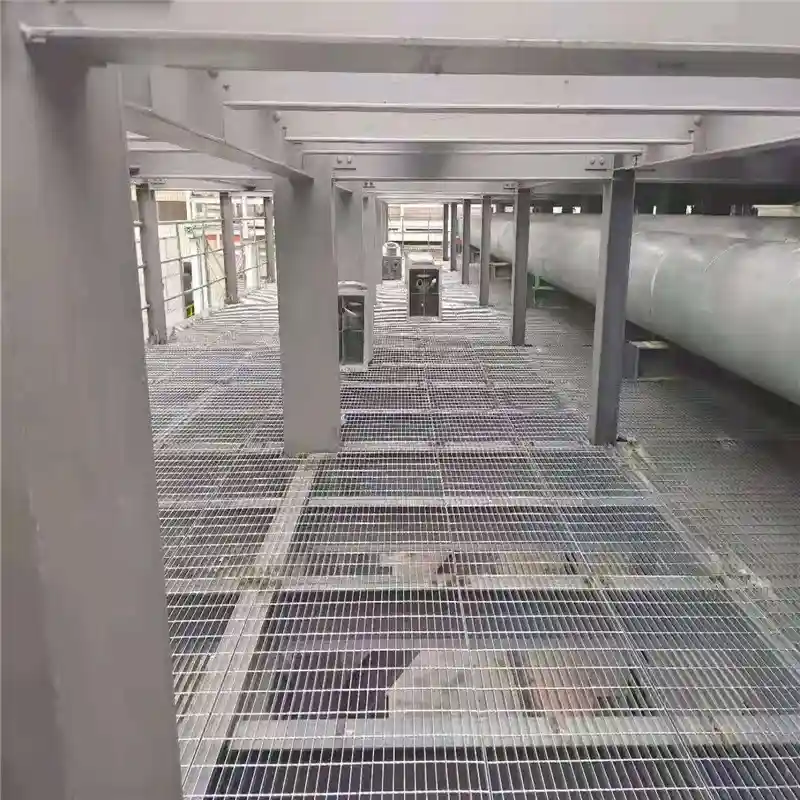
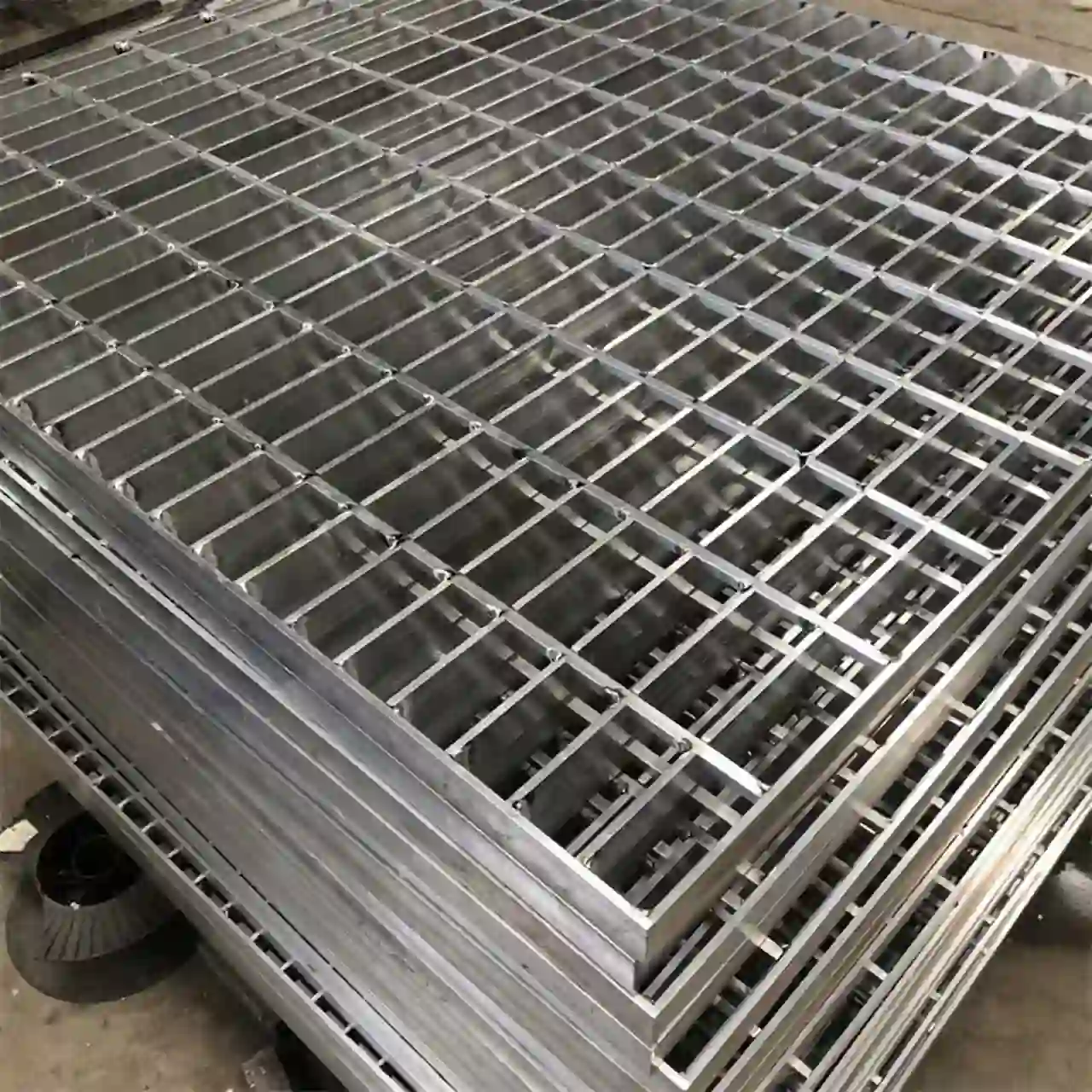
Steel grating is an open grid made from parallel load-bearing bars connected by cross bars. The bearing bars are installed across the support span and carry most of the structural load. Cross bars hold the panel together, maintain spacing, and provide lateral stability.
Steel grating can be welded, press-locked, swage-locked, or riveted. Welded grating is widely used in industrial platforms and walkways. Press-locked and swage-locked products offer other mesh and appearance options, while heavy-duty designs may use thicker or deeper bearing bars.
Plain bearing bars provide a smooth upper edge. Serrated bars have notches that can improve traction in wet, oily, muddy, or contaminated areas. Neither surface is completely slip-proof, and site safety also depends on drainage, cleaning, footwear, lighting, and handrails.
For standard bar configurations and dimensional terminology, see the guide to steel bar grating dimensions.
Expanded metal flooring is manufactured from a solid sheet of metal that is slit and stretched to create a mesh. The process forms connected strands and bonds without removing the slit material as waste. The resulting panel has a directional pattern and can be supplied in flat or raised configurations.
The sheet is cut in a controlled pattern and expanded. The strands remain connected at the bonds, creating an integral sheet structure. Strand width, strand thickness, mesh dimensions, sheet gauge, and expansion direction all affect strength, weight, opening size, and walking characteristics.
Raised expanded metal retains a three-dimensional profile after stretching. Its ridges can provide traction and stiffness. Flattened expanded metal is rolled after expansion to create a flatter surface, which may be easier to walk on or clean but changes the surface texture and section geometry.
Expanded metal flooring is available in carbon steel, galvanized steel, aluminum, and stainless steel, depending on the manufacturer. Material and finish should be selected for the operating environment rather than assumed from the mesh form.
The key structural distinction is the load path. Steel grating has identifiable bearing bars, so the design direction is usually clear. Expanded metal has connected strands forming a sheet-like grid, and its capacity depends on the orientation of the strands, sheet thickness, mesh size, support arrangement, and perimeter framing.
In a typical grating panel, bearing bars span between supports. Cross bars connect them but are not usually treated as the main spanning members. Drawings should mark bearing bar direction so the panel is installed correctly.
Expanded metal distributes load through the strand network, but the mesh is directional. The orientation of long and short mesh dimensions, strand direction, and support edges affects the panel response. Product-specific load data is needed for the actual orientation and span.
Steel grating fabrication includes bar preparation, joining, trimming, banding, and possibly galvanizing or painting. Expanded metal production relies on sheet slitting and expansion, followed by flattening or other finishing where specified.
Both products can be cut to size, but cutting may expose edges, interrupt structural members, or require a frame. Coated products may also need edge repair after fabrication.
Steel grating is often selected where the project requires high stiffness, defined bearing direction, longer spans, or heavy concentrated loads. Expanded metal flooring can support many pedestrian and maintenance applications, but the allowable span and load must be confirmed for the exact mesh and support configuration.
A load from a wheel, equipment foot, or dropped object is not equivalent to the same force distributed over the full panel. Wheel contact area, load position, travel direction, impact, and repeated traffic can govern the design.
For vehicle areas, use the equipment’s wheel or axle data and verify the complete panel-and-frame assembly. Do not assume that a product suitable for pedestrian access is suitable for forklifts or trucks.
A panel may meet a strength requirement but still deflect too much. Excessive movement can feel unstable, damage adjacent finishes, loosen fasteners, or create trip hazards at joints. Compare products using the same span and allowable deflection criteria.
Adding intermediate supports can reduce the required panel section, but it adds beams, connections, fabrication, and installation work. Compare the grating and support system together. A product with a low panel price may need more support steel to meet the same performance target.
Weight depends on material density, sheet thickness or bar size, mesh pattern, and panel dimensions. Expanded metal can use material efficiently because the sheet is slit and expanded, but it is not automatically lighter than every grating panel. Heavy-duty expanded sheet may weigh more than a light bar grating of a similar area.
Deep or thick-bar grating can be heavy and may need a crane, forklift, or mechanical lifting equipment. Panel weight should be known before planning transport, lifting, or manual removal for maintenance.
Expanded metal panels may be easier to handle when made from lighter sheet, but large panels can flex during lifting. Support them properly and avoid bending the mesh or damaging the edges before installation.
Steel grating often feels rigid because the bearing bars provide a clear structural direction. Expanded metal’s stiffness depends on the mesh geometry and perimeter support. A framed sheet may feel more stable than an unframed edge, so compare the installed assembly rather than a loose panel.
Both products allow water, air, and light to pass through, but the open area and opening shape differ.
Grating openings are set by bearing bar spacing, bar thickness, and cross-bar spacing. The open grid is useful for drainage and ventilation. Small openings may require close-mesh grating or an additional screen depending on the project.
Expanded metal openings are diamond-shaped or otherwise patterned, depending on the product. Strand width, mesh length, mesh width, and sheet thickness determine open area and visibility through the panel.
Open flooring can allow debris to fall through, which may be unacceptable above occupied spaces, equipment, or finished surfaces. Where object retention is needed, select an appropriate mesh, add a secondary tray, or use a closed flooring design.
Drainage depends on the underlying floor or channel, slope, and maintenance. A high open-area percentage does not prevent blockage from sediment, leaves, packaging, or process residue.
Open structures can improve airflow and daylight transmission around equipment. Compare the actual opening dimensions and orientation if ventilation or visibility is part of the design requirement.
Expanded metal can provide traction through its raised strands and textured surface. Serrated steel grating can provide traction through notched bearing bars. Both may be appropriate for wet or contaminated walking areas when properly selected.
Raised strands create a textured surface that can help footwear grip. The raised profile may be uncomfortable for kneeling, rolling small equipment, or moving materials that need a smooth surface.
Flattened mesh has a less pronounced profile. It may be easier to clean and more comfortable for some uses, but traction characteristics should be checked for the expected contaminants and slope.
Serrated bearing bars are commonly specified for outdoor platforms, stairs, wastewater plants, and oily process areas. The serration pattern should match the application, and the panel must still meet structural requirements.
Surface texture alone does not eliminate slip risk. Drainage, housekeeping, lighting, footwear, handrails, edge protection, and inspection all contribute to safe access. Where a standard slip test is required, specify its method and acceptance criteria.
Carbon steel is economical but can rust in wet or outdoor service. Hot-dip galvanizing provides a zinc coating for many general industrial environments. Paint and duplex systems may be selected for additional protection or appearance.
Stainless steel grating can be appropriate for hygienic, wet, or corrosive environments. Grade 304 suits many mild conditions, while 316 or 316L offers better resistance to many chloride exposures. Neither grade is immune to every chemical or seawater condition.
Aluminum expanded metal can offer low weight and good corrosion behavior in many atmospheric conditions. It can still be attacked by certain chemicals and can experience galvanic corrosion when connected to dissimilar metals in a wet environment.
Specify the surface treatment, preparation, coating standard, thickness where applicable, and repair procedure for field cuts. For stainless products, state whether pickling, passivation, or another surface treatment is required.
Selection should account for moisture, chlorides, acids, alkalis, solvents, temperature, UV exposure, abrasion, and cleaning chemicals. Product compatibility depends on the material and finish as well as the installation details.
Steel grating can be supplied in standard or custom panel sizes with banding, cutouts, toe plates, stair nosing, lifting handles, and fastening details. Custom cutouts that interrupt bearing bars may need reinforcement or additional support.
Expanded metal can be cut into panels, framed around openings, and supplied with different mesh sizes, strand dimensions, sheet thicknesses, and surface finishes. The orientation of the mesh should be shown on the drawing because it affects appearance and structural behavior.
Large panels reduce joints but may require special lifting and delivery arrangements. Smaller panels are easier to remove for maintenance but require more edge treatment and fasteners per area.
Openings for pipes, columns, valves, and equipment should be dimensioned before fabrication. The panel edge may need banding, a frame, or a separate support. Field cutting can reduce capacity and leave sharp edges, so approved factory fabrication is usually easier to control.
Steel panels are commonly installed on steel beams or support angles using clips, bolts, or welds. Bearing bars must span in the correct direction. Support widths should provide adequate bearing and prevent rocking.
Expanded metal flooring is generally supported by framing, channels, or angles around the perimeter and at intermediate points as required by the design. The mesh should be oriented according to the approved drawing, and the edges should be secured to prevent movement or unraveling at cut boundaries.
Before replacing one product with another, check the existing frame’s dimensions, stiffness, corrosion condition, bearing surface, and fastener locations. The new product may have a different depth, edge detail, dead load, or thermal movement.
Fasteners should be compatible with the panel and support material. Wet contact between dissimilar metals can cause galvanic corrosion, particularly in aluminum assemblies. Isolation washers, coatings, or compatible fasteners may be needed.
Steel cutting and welding may require hot-work controls, coating repair, and fire prevention. Expanded metal cutting can leave sharp edges and may require deburring and edge framing. Both products need safe lifting, secure fastening, and protection of openings during installation.
Steel grating often has a lower initial cost for standard industrial panels, particularly in carbon or galvanized steel. Expanded metal pricing depends on sheet thickness, mesh pattern, material, framing, and finishing. Custom formed or framed panels may cost more than simple sheets.
Coated steel may require inspection and coating repair. Stainless steel needs cleaning and inspection for deposits or localized corrosion. Expanded metal may be easier to remove in small panels, but its strands and edges should be checked for deformation, cracking, corrosion, and loose framing.
Steel grating can often be repaired by replacing a panel or, under an approved procedure, repairing a damaged bar or connection. Expanded metal damage may require replacing a larger framed section if the mesh has torn or deformed. Repair feasibility depends on access, load path, and the manufacturer’s recommendations.
Compare purchase, support steel, installation, coating maintenance, cleaning, repairs, lifting, replacement, and downtime over the same period. A lower-cost panel may not be the best value if it requires more frequent maintenance or additional framing.
For heavy vehicle loads, long spans, high impact, or safety-critical structures, use project-specific engineering data regardless of product type.
Identify uniform, concentrated, wheel, and impact loads. Provide clear spans, support dimensions, bearing direction, and allowable deflection.
Set limits for clear opening, object retention, heel safety, drainage, ventilation, and light transmission. Compare actual opening dimensions rather than relying on product names.
List moisture, salts, chemicals, temperature, UV exposure, abrasion, and cleaning agents. Select material and finish for those conditions.
Consider plain or serrated steel bars, raised or flattened expanded metal, and any required slip-test criteria. Include slope, footwear, and contaminants in the selection.
Confirm frame dimensions, bearing length, intermediate supports, fasteners, lifting access, and compatibility with existing structures. Consider how panels will be removed for maintenance.
Include fabrication, edge framing, coating, fasteners, freight, installation, maintenance, and replacement. Request quotes using the same drawings and load criteria.
| Project Priority | Starting Option to Evaluate | Key Check |
|---|---|---|
| High load and long span | Steel grating | Bearing bar size, span, support frame, and deflection |
| Continuous textured sheet surface | Raised expanded metal | Strand direction, support arrangement, and walking comfort |
| High drainage and ventilation | Either product, depending on opening pattern | Open area, debris retention, and maintenance access |
| Corrosive outdoor environment | Galvanized or stainless grating; compatible expanded metal material | Chemical exposure, coating, alloy, and dissimilar-metal contact |
| Frequent panel removal | Smaller modular panels of either type | Panel weight, lifting method, and fastener access |
Which is stronger, steel grating or expanded metal flooring? Steel grating is often stronger and stiffer for defined spans and heavy concentrated loads because its bearing bars are designed to span between supports. Expanded metal flooring can be suitable for many access applications, but its capacity depends on sheet thickness, strand geometry, orientation, framing, and support spacing. Compare load data for the exact products and installation.
Is expanded metal flooring more slip-resistant than steel grating? Raised expanded metal can provide good traction through its textured strands, while serrated steel grating uses notched bearing bars to improve grip. The better surface depends on water, oil, slope, footwear, cleaning, and traffic. Neither product is automatically slip-proof, so specify a surface and test method suited to the site conditions.
Which is more suitable for drainage, steel grating or expanded metal? Both can provide drainage and ventilation. Steel grating openings are set by bearing bar and cross-bar spacing; expanded metal openings depend on mesh dimensions and strand geometry. Select based on required flow, clear openings, debris control, small-object retention, and cleaning access.
