
Bolted and clip-fixed steel grating can look identical after installation, but the fixing details affect how securely panels stay in place, how quickly they can be removed, and how much work is required when equipment below the floor needs attention. Direct bolting typically fastens a panel through prepared holes or plates into the support structure. Clip fixing grips the grating and support with a separate hardware assembly, often without drilling through the panel. Many grating clips themselves use a bolt, so the distinction in this guide is between direct through-panel bolting and removable hold-down clips. Neither method increases the basic load capacity of an undersized panel. The right choice depends on traffic, vibration, uplift, support geometry, corrosion exposure, removal frequency, and the consequences of a loose or missing fixing.
| Selection Factor | Directly Bolted Grating | Clip-Fixed Grating |
|---|---|---|
| Connection | Fastener passes through a prepared hole or mounting plate into the support | Clip grips the grating and support; its own bolt commonly tightens the assembly |
| Panel preparation | Usually requires holes, end plates, or other prepared fixing points | Many systems use the existing grating openings without drilling the panel |
| Support preparation | May require drilled and tapped holes, through-bolts, welded nuts, or anchors | Depends on clip design; some grip a flange, while others still require a prepared support |
| Removal | Straightforward when fasteners remain accessible and free of corrosion | Often convenient for panels opened regularly, depending on clip access |
| Resistance to uplift and movement | Can provide strong positive restraint when engineered correctly | Can also provide positive restraint when rated and installed for the demand |
| Field adjustment | Hole alignment can limit adjustment | Many clips allow some positioning flexibility |
| Typical concern | Misaligned holes, damaged threads, or inaccessible underside nuts | Wrong clip fit, insufficient engagement, or loosening from poor installation |
| Best starting point | Known support positions, demanding restraint, or controlled access | Repeatable panel installation and maintenance access without panel drilling |
Both methods can be suitable for industrial platforms, trench covers, and walkways. Their performance depends on the complete connection: grating geometry, fixing hardware, support steel, fastener material, installation quality, and inspection.
Bolted steel grating is a panel secured directly to its supporting structure with bolts or screws passing through prepared fixing points. The fixing point may be a hole in a bearing bar, a welded mounting tab, an end plate, or a separate plate attached to the grating.
The fastener can engage a threaded support, a welded nut, a captive nut, or a through-bolt with a nut beneath the structure. The arrangement should be selected with installation and future removal in mind. An underside nut may be easy to install on a ground-level frame but difficult to reach beneath an elevated platform.
Direct bolting is often chosen when the fixing locations are known before fabrication and the project needs a defined, inspectable connection. The holes and plates must be detailed so they do not weaken critical bearing bars or interfere with the walking surface.
Clip-fixed steel grating is held down by a hardware assembly that engages the grating and its support. A typical assembly has a top saddle or plate, a lower bracket or hook, and a bolt that tightens the two pieces together. Other designs use proprietary clamps or self-drilling fasteners.
The clip type must match the bearing bar depth, spacing, cross-bar arrangement, and support shape. A clip designed for a standard open mesh may not fit close-mesh grating, a thick support flange, or a deep heavy-duty panel.
Because clips often contain bolts, “clip-fixed” does not mean “bolt-free.” It means that a separate gripping assembly provides the connection instead of a fastener passing directly through a prepared panel fixing point.
The installer positions the panel, aligns the fixing holes with the prepared support, installs the specified bolts and washers, and tightens them according to the approved connection detail. Thread engagement, washer placement, and access for a wrench or driver must be checked.
Where the support needs field drilling, the installer should confirm that drilling is permitted and that the hole does not compromise the beam, flange, embedded part, or protective coating. Field modifications may require coating repair.
The installer places each clip in the approved position, checks that it engages the required bearing bars and support surface, then tightens its fastener. The clip must sit correctly rather than bearing on an unsuitable cross bar, weld projection, or sloped edge.
Some clips can be installed entirely from above. Others require access beneath the support. Check this before selecting a clip for a trench, elevated platform, or confined location.
Both systems may require sockets, spanners, drivers, or torque tools. Direct bolting may also require drilling and thread preparation when supports are not preformed. Clip fixing may need fewer panel modifications but can require careful positioning around the grating mesh.
A fixing system may need to resist several different actions. These include uplift from wind or pressure, lateral movement from traffic, vibration, panel rotation, and accidental displacement during maintenance. The required restraint should be stated in the design rather than inferred from the panel’s weight.
Direct bolting can create a clear load path from the panel through the fastener into the support. Its performance depends on bolt strength, hole and plate geometry, edge distances, support thickness, thread engagement, and installation.
A strong bolt does not guarantee a strong connection if the mounting tab bends, a hole tears, the support flange is too thin, or the fastener can loosen.
Clip performance depends on its geometry, contact surfaces, bolt preload, fit to the grating, and engagement with the support. A correctly selected clip can provide substantial positive restraint. A clip that only appears to sit over the panel, without proper lower engagement, may provide little resistance to uplift.
Equipment vibration and frequent wheeled traffic can loosen either connection type. Where vibration matters, the engineer should specify suitable locking features, tightening requirements, and an inspection interval. Do not add a generic lock washer or adhesive without checking compatibility with the approved fastener system.
Outdoor platforms, offshore installations, ventilation floors, and covers above pressurized spaces may experience uplift. Calculate the required restraint and check the complete fixing arrangement. An open grating panel can still be displaced by wind or pressure under particular conditions.
Fixings hold the grating in place; they do not correct inadequate bearing or an uneven frame. A panel that rocks on a distorted support can repeatedly load and loosen its connections. Repair the support condition as part of the installation.
Grating load capacity is governed primarily by bearing bar dimensions, spacing, material, clear span, support condition, and load type. Changing from clips to direct bolts does not turn a pedestrian panel into a forklift-rated panel.
For ordinary walkways, either fixing method may be appropriate if the panel meets its load and deflection requirements and the connections provide the necessary restraint. Removable sections should be clearly identified and secured after every opening.
Cart wheels can create concentrated loads near panel edges and joints. Check the grating and its frame for those loads. Hardware should be positioned or recessed so wheels do not strike it, loosen it, or create an obstruction.
Vehicle crossings require wheel-load verification of the panel, banding, support frame, and connections. Braking and turning can add lateral forces; repeated impacts can damage hardware or allow movement.
Direct bolting may be selected where a defined engineered connection is needed. A rated clip system may also be suitable if its performance has been verified for the actual traffic and support. The fixing method alone does not establish a vehicle rating.
A trench cover can lift, rotate, or shift if its edge bearing and restraint are inadequate. The design should check the cover under unfavorable wheel positions, including near an edge or joint. Frames, anchors, and fasteners are part of the load path.
For more on the dimensions that control panel performance, see the guide to steel bar grating dimensions and specifications.
Trenches, drains, pipe routes, valves, and equipment below a platform may require regular access. The best fixing method allows workers to open the correct panel safely and reinstall it reliably.
Many clip systems can be released from above and installed without aligning a panel hole to a threaded support. This can make them convenient where multiple panels are removed for cleaning. Actual removal time depends on hardware access, corrosion, dirt, and the number of clips.
Direct bolts can also be removed quickly when their heads are accessible and the threads remain sound. Captive nuts can simplify the work. Through-bolts with loose nuts below the platform may be less convenient, especially above deep trenches or operating equipment.
Repeated removal increases the chance of misplaced bolts, clips, and washers. Captive hardware, retained clips, panel marking, and a defined reinstallation procedure can reduce this risk.
A large steel panel may require a lifting device even after its fasteners are removed. Specify panel weight, lifting points, safe access, and temporary protection of the open trench. A cover should not be left unsecured because it is expected to be opened again soon.
| Access Pattern | Likely Practical Consideration |
|---|---|
| Rarely opened platform panel | Choose the required restraint and straightforward inspection; either method may work |
| Periodic drain cleaning | Favor hardware accessible from the working side and easy to reinstall |
| Frequent equipment inspection | Consider captive hardware, handles, or a hinged access assembly |
| Restricted or secured access | Specify controlled removal and compatible locking hardware |
Clip fixing can reduce installation time when panels and supports are already compatible with a standard clip. It may avoid drilling individual panels and preparing matching holes in each support.
Direct bolting can be efficient when holes, plates, and threaded supports are accurately fabricated in advance. On repetitive platforms, preplanned bolting details may give installers predictable fixing positions and inspection points.
Compare installation time using the complete method, including panel preparation, support preparation, hardware placement, tightening, coating repairs, and final inspection. A low hardware price does not guarantee the lowest installed cost.
Any removable grating panel can become a hazard if it is returned to its frame without being secured. Use panel marks, an inspection procedure, and a clear responsibility for reinstalling fasteners after maintenance.
Utility trenches and equipment openings may need restricted access. Direct bolts can use tamper-resistant heads or concealed nuts. Some clip systems also support tamper-resistant fasteners. The hardware should be chosen for the required access control while remaining practical for authorized maintenance.
Fixings must resist the movement specified by the designer. Toe plates, small-opening mesh, or secondary trays may also be needed where falling tools or materials could reach people or equipment below.
Fastener heads and clip tops should not project into the path of small wheels or create a trip point. In stair treads, identify any hardware near the nosing and confirm that it does not interfere with footing.
A heavy panel can still slide or rotate when struck near an edge. Positive restraint should be provided wherever the design calls for it.
Outdoor and industrial exposure affects both the grating and its fixing hardware. Water, chlorides, chemicals, abrasion, and trapped deposits can shorten the life of bolts, clips, threads, and support surfaces.
Galvanized panels are commonly paired with compatible galvanized or otherwise corrosion-protected hardware. Check whether the fastener’s coating is appropriate for the environment and whether tightening damages a protective layer.
Stainless panels normally require compatible corrosion-resistant fasteners. In coastal or chloride-bearing environments, the fastener grade, crevice geometry, and maintenance access matter. An ordinary stainless bolt is not automatically suitable for every seawater or chemical condition.
A stainless clip on a galvanized support, or another mixed-metal connection, can create galvanic corrosion conditions when the assembly remains wet. The degree of risk depends on contact area, electrolyte, coating condition, and exposure. Isolation or other protection may be needed.
Bolted joints and clip assemblies have narrow gaps where water and deposits can remain. Select hardware that can be inspected, cleaned, and replaced. Avoid positioning fasteners in low points where aggressive liquid collects.
Specify the actual chemicals, concentration, temperature, and cleaning procedure. Both the clip body and its bolt need to resist the environment. A durable grating panel can still become loose if its fixings corrode first.
For material selection in more aggressive environments, see the guide to 316 stainless steel grating applications.
Direct bolting requires suitable holes, threads, tabs, or access for a nut. Clips must engage the actual flange shape and thickness. Check whether the support has enough free edge for the lower clip component.
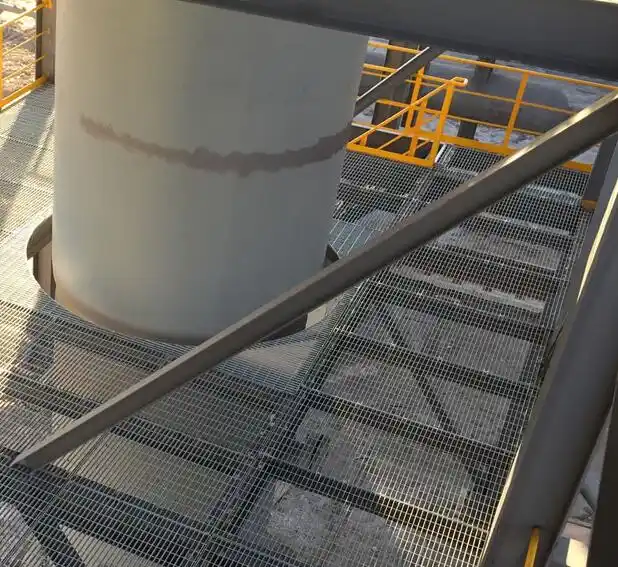
Grating over concrete often bears on embedded steel angles or fabricated frames. The fixing detail may attach to the embedded metal, to an anchored plate, or to a purpose-designed frame. Drilling into concrete should follow the approved anchor design and edge-distance requirements.
A clip designed for widely spaced bars may not fit close mesh. Conversely, a large top saddle can block drainage or interfere with a narrow walkway pattern. Confirm compatibility using the exact grating geometry.
Serrations can affect where a clip or washer sits. Hardware should bear on a suitable surface and should not negate the traction provided by the walking profile.
Deep or thick bearing bars may require clips with a different reach or directly bolted mounting plates. The fastening design should be checked for uplift and lateral movement in addition to the panel’s vertical load rating.
Although the panel may be steel, supports or adjacent components can be aluminum or stainless steel. Confirm mechanical compatibility, thermal movement, and corrosion protection for the complete assembly.
| Project Detail | Direct Bolting Check | Clip-Fixing Check |
|---|---|---|
| Support flange | Hole position, thickness, and thread or nut access | Flange thickness, lower engagement, and clearance |
| Grating mesh | Prepared mounting point and remaining bar strength | Top component fit between or across bars |
| Panel depth | Bolt length and plate position | Clip reach and bolt length |
| Access from below | Required for some through-bolt designs | Required for some clip designs |
| Frequent removal | Thread durability and captive hardware | Clip accessibility and retained components |
| Wet exposure | Thread and hole corrosion | Crevice and contact corrosion beneath clip parts |
The cost difference between direct bolts and clips cannot be expressed as one reliable price per square meter. Hardware price, preparation, installation time, inspection, and future removal all affect total cost.
For a large repetitive platform, standard clips may reduce hole preparation and speed installation. For a small number of secured covers with prepared frames, direct bolting may be straightforward and economical. Actual productivity depends on access and the chosen hardware.
A panel opened every week may consume more labor over its service life than one opened once a year. If fasteners seize, disappear, or require access beneath the structure, the initial hardware saving can be lost quickly.
Compare purchase, preparation, installation, periodic inspection, removal, replacement hardware, coating repairs, and downtime over the same study period. The best value is the connection that remains secure and can be maintained in the intended environment.
Inspect for missing or loose hardware, bent clips, damaged mounting tabs, stripped threads, corrosion, and panel movement. Check that every panel remains seated on its supports.
Clean the contact surfaces, check the support condition, and replace damaged hardware. Reinstall the panel in its original orientation and position. Tighten the specified fasteners and verify that no edge rocks or lifts.
Forcibly removing a seized fastener can damage threads, coating, or the support. A maintenance plan should identify acceptable replacement hardware and a repair method for damaged supports.
A new directly bolted panel must align with existing support holes or be supplied with an approved revised detail. A clip-fixed panel may allow more flexibility, but the new bearing bar spacing and depth must still fit the clips.
Record clip or bolt type, material grade, quantity, locations, tightening requirements, and approved substitutions. This makes future replacement faster and reduces the risk of installing hardware that merely looks similar.
Identify wind uplift, vibration, traffic movement, security, and any pressure beneath the panel. Select a connection with documented capacity and a clear load path into the support.
For frequent cleaning or inspection, prioritize access from the working side, retained hardware, practical lifting, and reliable reinstallation. Either method can serve removable panels when designed for repeated use.
Measure flange thickness, available edge, underside clearance, and access for tools. Confirm compatibility with the exact grating depth and mesh. A clip that cannot engage the support or a bolt that cannot reach its nut has no useful installed value.
Select fastener and clip materials for the same exposure considered when selecting the grating. Review galvanic contact, trapped moisture, chemicals, and the availability of replacement parts.
Ask suppliers to quote the panel and fastening system together. Include prepared holes or tabs, clips, bolts, support modifications, coating repair, installation labor, and documentation. This makes the price comparison relevant to the installed project.
| Project Situation | Useful Starting Option | Critical Check |
|---|---|---|
| Repeated panels on compatible steel flanges | Clip fixing | Fit, engagement, uplift rating, and installation access |
| Known fixing locations on a fabricated frame | Direct bolting | Hole alignment, support strength, and thread access |
| Frequently removed drain covers | Whichever system provides accessible, retained hardware | Safe lifting and reliable reinstallation |
| High vibration or vehicle movement | Engineered direct bolts or rated clips | Lateral restraint, loosening resistance, and inspection interval |
| Restricted utility opening | Controlled-access fastener system | Authorized removal without creating a maintenance obstacle |
| Coastal or chemical area | Corrosion-compatible hardware for either system | Crevices, dissimilar metals, and replacement availability |
Steel grating projects are often priced by panel area, but fixing hardware and installation may be separate line items. Include both in the request for quotation so the panel arrives with a connection that fits the actual supports. The steel grating pricing and load guide provides broader context for comparing panel specifications and project costs.
Are grating clips as strong as bolts?
A suitable, correctly installed clip can provide strong positive restraint, and many clips use bolts to generate that restraint. Direct bolting can also provide a strong connection. Neither method has a universal strength advantage: compare the specified uplift and lateral loads with the rated capacity of the complete connection, including the grating, support, and fastener.
Which fixing is better for removable grating?
Clip fixing is often convenient because many systems can be released from above without prepared holes in the panel. Direct bolts can be equally practical when they use accessible heads and captive nuts. For frequently opened panels, the deciding factors are safe lifting, hardware that will not be lost, corrosion resistance, and reliable reinstallation.
Do clips or bolts increase steel grating load capacity?
No. Fasteners restrain a correctly designed panel against movement and uplift, but they do not make undersized bearing bars suitable for a longer span or a heavier wheel load. Check the grating, frame, bearing length, and fastenings as one system for the required traffic and operating conditions.
