
Steel grating and composite trench covers are both used to protect drainage channels, utility trenches, cable routes, process drains, and service openings. Steel grating offers high stiffness, strong impact resistance, predictable structural behavior, and good performance under heavy or concentrated loads. Composite covers, including FRP, SMC, polymer concrete, and resin-based systems, are lighter and can provide excellent resistance to many corrosive environments. The correct choice depends on the actual traffic, span, chemical exposure, fire requirements, drainage needs, access frequency, and maintenance plan. This guide compares steel grating and composite trench covers so engineers, contractors, and purchasing teams can select a cover that meets both safety and lifecycle requirements.
| Selection Factor | Steel Grating | Composite Trench Covers |
|---|---|---|
| Structural stiffness | Usually high, especially with deep bearing bars | Depends strongly on resin, reinforcement, profile, and design |
| Heavy wheel and impact loads | Often preferred for severe traffic and repeated impact | Available for traffic service, but requires product-specific verification |
| Weight | Relatively heavy, particularly for deep or heavy-duty panels | Usually much lighter and easier to handle |
| Corrosion resistance | Depends on carbon steel coating or stainless steel grade | Depends on resin, reinforcement, surface, and chemical compatibility |
| Electrical conductivity | Conductive and may require bonding or grounding | Usually insulating unless a conductive formulation is specified |
| Fire behavior | Steel is noncombustible, although strength decreases at high temperature | Resin may burn, soften, produce smoke, or require fire-retardant formulation |
| Installation | May require mechanical lifting and stronger handling equipment | Often easier to place and remove manually |
| Initial price | Often economical for standard industrial and heavy-duty designs | May cost more than galvanized steel but can reduce installation labor |
| Recycling | Established steel recycling channels | Composite recycling is more difficult |
These are general tendencies. A stainless steel grating panel, a heavy-duty galvanized cover, a molded FRP cover, and a polymer concrete cover should be compared using their actual specifications and test data.
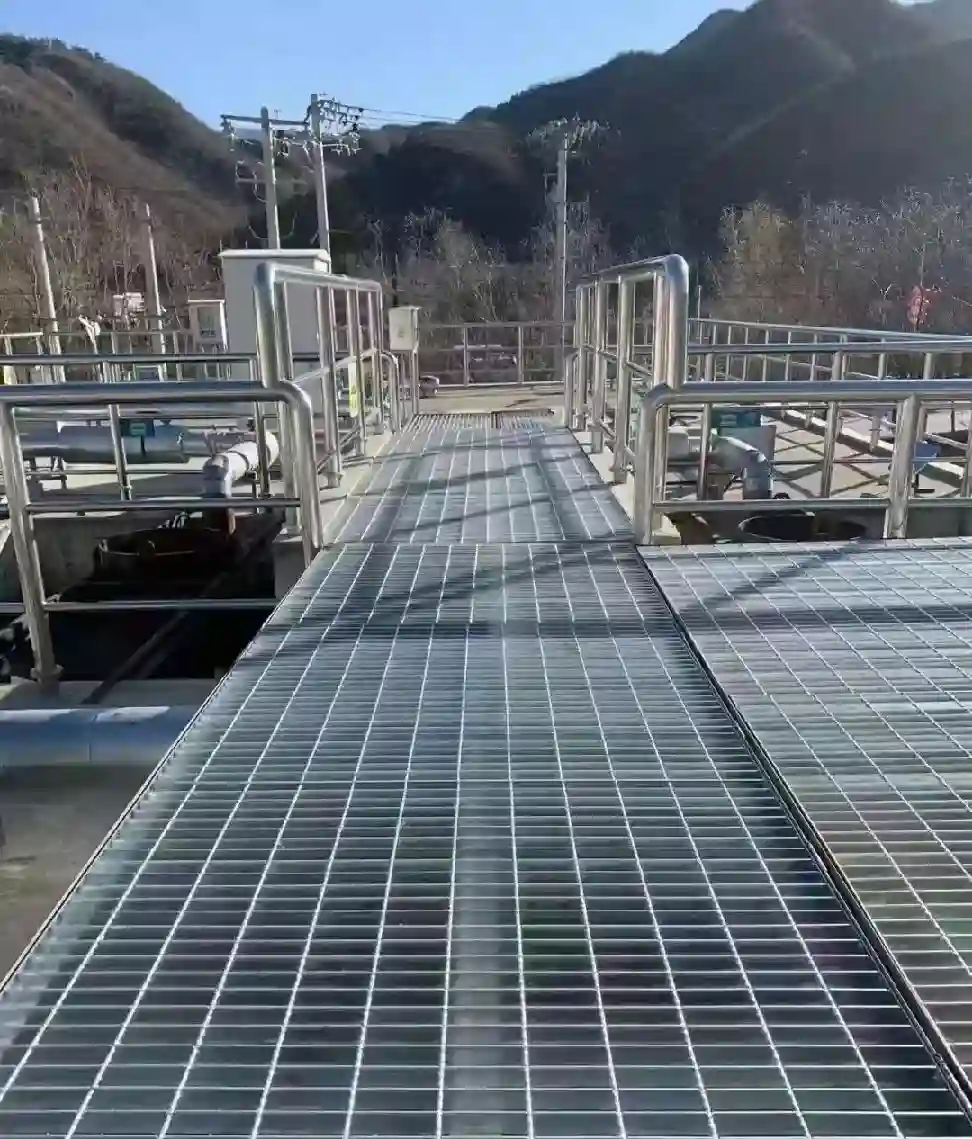
Steel grating is an open grid manufactured from parallel bearing bars connected by cross bars. In a trench-cover application, the bearing bars normally span across the channel and transfer load to support ledges or frame angles on both sides.
Steel grating can be manufactured as welded, press-locked, swage-locked, or riveted grating. The bearing bars may be plain or serrated. Common materials include untreated carbon steel, hot-dip galvanized steel, 304 stainless steel, and 316 or 316L stainless steel.
Untreated carbon steel has good mechanical strength and a low initial material cost, but it normally requires a protective coating for permanent wet or outdoor service. Paint, galvanizing, or another coating system must be included in the maintenance plan.
Hot-dip galvanized grating uses a zinc coating to protect carbon steel. It is widely used for drainage channels, walkways, utility areas, factories, warehouses, and outdoor platforms where the environment is not excessively aggressive.
Stainless steel forms a passive protective film and avoids dependence on a separate zinc coating. 304 is common in mild wet and hygienic applications. 316 and 316L offer improved resistance to many chloride-bearing environments, including selected marine, coastal, wastewater, and chemical applications.
For dimensions, load factors, and product configurations, see the CSSP guide to steel bar grating dimensions.
Composite trench covers are covers made from a combination of reinforcing fibers, resin, mineral fillers, or polymer binders. The term “composite” describes a family of products rather than one material with one performance level.
FRP grating combines glass fibers with a polymer resin. It may be molded or pultruded. Molded panels distribute reinforcement through the panel, while pultruded panels usually contain continuous fibers aligned along the bearing bars.
FRP trench covers are lightweight, electrically insulating, and resistant to many chemicals. Their load performance depends on the resin, fiber content, panel depth, support span, surface profile, and long-term deflection criteria.
Sheet molding compound and other resin-molded covers use polymer resin, glass reinforcement, mineral fillers, and additives formed under heat and pressure. They can be produced with closed or textured surfaces, integrated logos, drainage patterns, and traffic-rated profiles.
Polymer concrete covers combine mineral aggregate with a polymer binder. They are generally heavier than FRP but can provide strong compression performance, good chemical resistance, and a solid, closed surface. Their weight and brittle behavior should be considered during lifting and impact events.
Some trench covers use recycled polymer or resin systems with reinforcement. These products may be suitable for pedestrian or light-duty areas, but their stiffness, creep resistance, temperature limits, and traffic rating must be verified for the intended application.
A composite cover specification should identify the material family, resin or binder, reinforcement, panel construction, surface, fire behavior, chemical compatibility, load rating, span, and test method. The word “composite” alone does not establish structural capacity or service life.
Open steel grating allows water, air, light, and small debris to pass through. It is useful where drainage and ventilation are important. The opening pattern can be selected to control object fall-through, heel safety, and cleaning requirements.
Many composite trench covers have a mostly solid or textured upper surface. This can prevent small objects from falling into the channel and can provide a cleaner visual appearance. Drainage must then be provided through molded slots, perforations, channel edges, or a separate drainage system.
Steel grating can be supplied as removable panels, hinged covers, banded panels, reinforced access covers, or frames with lifting handles. Heavy-duty steel covers may include load-bearing edge bars, intermediate supports, or bolted restraints.
Composite covers can be supplied as removable slabs, hinged panels, modular planks, or covers with integrated frames. Some products use ribbed undersides or molded beams to increase stiffness without making the top surface excessively thick.
Steel grating may use plain or serrated bearing bars. Composite products may use molded textures, bonded grit, raised patterns, or smooth closed surfaces. The surface design affects slip resistance, cleaning, appearance, and wear.
Load capacity is one of the most important differences between steel grating and composite trench covers. Both materials can be engineered for pedestrian and vehicle applications, but their design behavior and failure modes differ.
Steel grating provides high stiffness and predictable bending performance. Deeper bearing bars can carry higher loads and reduce deflection. Steel also has useful ductility, so severe overload may result in visible bending before complete failure.
Composite covers depend on fiber orientation, resin properties, panel profile, temperature, and sustained loading. Pultruded products are directional, so the load-bearing direction must be installed correctly. Composite materials can also experience creep, meaning deflection may increase under a constant load over time.
Both steel and composite covers can be designed for pedestrian areas. The specification should state the clear span, uniform load, concentrated load, allowable deflection, opening size, and slip-resistance requirement.
Passenger cars and service vehicles create concentrated wheel loads. A cover designed for pedestrians should not be assumed suitable for vehicles. The frame, edge support, cover thickness, wheel footprint, and dynamic effects require verification.
Forklifts, trucks, loaders, and industrial vehicles can impose high local forces and impact. Steel is often favored in these areas because of its stiffness and toughness. Traffic-rated composite covers are available, but they require product-specific test data and installation details.
A formal load class or test load is not the same as the total weight of a vehicle. The design must consider wheel or axle reactions, contact area, load position, traffic frequency, braking, turning, impact, and support conditions.
| Traffic Condition | Steel Grating Consideration | Composite Cover Consideration |
|---|---|---|
| Pedestrian access | Standard grating may be suitable with correct span and openings | Lightweight FRP or molded covers may be convenient |
| Maintenance carts | Check concentrated wheel loads and panel joints | Check wheel footprint, creep, and edge strength |
| Passenger vehicles | Use a verified wheel-load design and strong frame | Use a traffic-rated product with documented testing |
| Forklifts and heavy trucks | Often preferred for impact and repeated wheel loading | Possible with specialized products and strict support requirements |
Galvanized steel performs well in many ordinary atmospheric and industrial environments. Its zinc coating can be consumed by acidic liquids, strong alkalis, chlorides, abrasion, and persistent wet deposits.
304 and 316 stainless steel do not rely on a coating for basic corrosion resistance. Grade 316 generally provides a better margin against chloride pitting and crevice corrosion than 304. Stainless steel still needs proper drainage, cleaning, welding treatment, and compatible fasteners.
FRP does not rust, and a compatible resin can resist many acids, alkalis, salts, and wastewater chemicals. The exact chemical resistance belongs to the resin system and exposure conditions. Polyester, vinyl ester, epoxy, phenolic, and specialty resins have different limits.
Polymer concrete can resist many corrosive liquids and provide a dense, closed surface. The binder, aggregate, temperature, chemical concentration, and joint detail determine suitability. Some chemicals can attack the polymer binder or penetrate cracks and joints.
Composite covers avoid electrochemical chloride pitting, which can be a major advantage in marine and deicing-salt environments. Galvanized steel may lose zinc more quickly, 304 can pit under severe exposure, and 316 usually provides better resistance but is not immune.
Steel covers can develop corrosion beneath clips, frames, deposits, and overlapping edges. Composite covers avoid metal rust but may still retain chemical liquids in joints or suffer resin attack at cut edges. Good drainage and accessible cleaning remain important for both systems.
Composite trench covers are often substantially lighter than steel covers of comparable coverage. This can reduce manual-handling effort, lifting equipment, freight weight, and installation time.
Deep steel bearing bars and traffic-rated panels can be heavy. Plan bundles, lifting points, cranes, forklifts, rigging, and safe panel placement. Heavy covers may be difficult to remove for routine channel cleaning without lifting assistance.
FRP and other composite covers are generally easier to carry and remove. They should still be protected from dropping, dragging, sharp impacts, and unsupported bending. A lightweight panel can be damaged if workers use it as a temporary bridge before it is installed on the specified supports.
Steel installation may involve more lifting and alignment work, but steel panels can tolerate some handling abuse and are familiar to many contractors. Composite covers can reduce lifting effort and hot work, but cutting generates dust and the installation must respect the manufacturer’s orientation and fastener requirements.
Low-weight composite covers can be useful where an existing frame has limited reserve capacity. The frame condition still needs inspection. A weak or corroded frame cannot be made safe simply by replacing the cover with a lighter material.
Steel can be cut and re-banded using established fabrication methods, although hot cutting can damage galvanizing and requires fire controls. FRP can be cut mechanically with carbide or abrasive tools, but workers need controls for fiberglass dust and exposed fibers.
Open grating allows water and air to pass directly through the panel. This can reduce surface ponding and improve ventilation in channels containing pipes, cables, pumps, or process equipment.
Openings must be selected to control small-object fall-through, shoe heels, wheels, and tools. Debris can still collect below the grating, especially where the channel has low flow or limited cleaning access.
Closed composite covers can prevent tools, trash, and small objects from entering the trench. They may also provide a more continuous walking or vehicle surface. Drainage depends on slots, holes, edge gaps, surface slopes, or the channel design beneath the cover.
A cover with a high open area does not guarantee adequate drainage if the channel is undersized or blocked. A closed cover with slots can also drain effectively when the slot area, arrangement, and maintenance plan are suitable.
Open grating permits visual inspection but may require removal for sediment cleaning. Closed covers can hide the channel condition and should be designed for safe lifting or hinged access.
| Requirement | Open Steel Grating | Closed or Slotted Composite Cover |
|---|---|---|
| Surface drainage | Usually direct and visible | Depends on molded slots, holes, or edge drainage |
| Ventilation | Generally high through open mesh | Lower for closed panels; verify required airflow |
| Small-object retention | Requires suitable mesh opening | Usually better with a closed surface |
| Visual inspection | Channel contents are visible | Access panels or lifting are needed for inspection |
| Debris accumulation | Debris can enter the channel | Surface debris may remain on top but is easier to sweep in some designs |
Slip resistance depends on the surface, contamination, drainage, slope, footwear, lighting, and maintenance. Neither steel nor composite material is automatically slip-proof.
Serrated bearing bars have notched tops that improve traction in wet, oily, muddy, or contaminated areas. They are common for industrial stairs, outdoor walkways, wastewater facilities, and chemical plants.
FRP covers can use bonded grit, molded-in grit, concave surfaces, or textured patterns. Gritted surfaces can provide strong traction but may wear under heavy traffic and can be uncomfortable where workers kneel or handle materials directly on the panel.
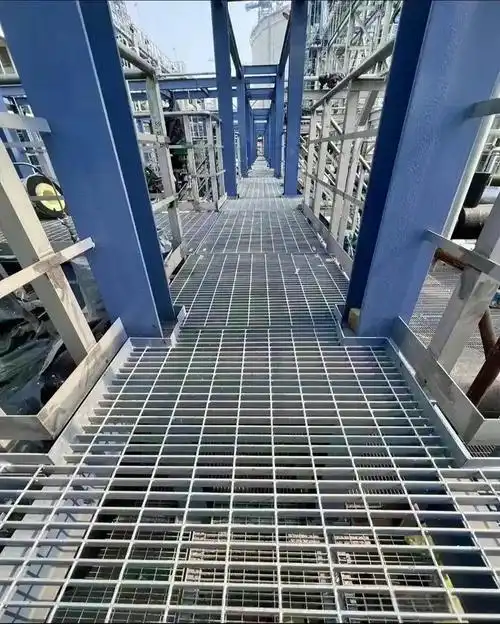
A textured closed cover can provide a continuous walking surface, but water and oil may remain on top if the drainage design is inadequate. The surface should be selected according to the expected contaminant and cleaning process.
Panel edges, joints, lifting handles, hinges, and frame transitions should be flush or clearly detailed. Uneven supports can create rocking and trip hazards regardless of the cover material.
Where a cover can be removed, the opening should be protected during maintenance. Platforms above occupied areas may need toe plates or kick plates to prevent tools and materials from falling.
Steel and composite covers deteriorate in different ways. A maintenance program should inspect both structural condition and the environment around the cover.
Steel grating should be cleaned to remove chloride deposits, grease, process chemicals, and debris. Carbon steel coatings may need repair. Stainless steel should be cleaned with compatible products and tools that do not embed iron particles.
Composite covers should be cleaned with products compatible with the resin or binder. Strong solvents, oxidizers, or high-pressure cleaning can damage some systems. Follow the manufacturer’s recommended water pressure, temperature, and chemical limits.
There is no universal service-life number for either material. Exposure, loading, temperature, drainage, surface treatment, installation quality, and maintenance determine how long the cover remains safe and functional.
A composite cover may outlast galvanized steel in a chemically aggressive wet well, while a steel cover may outlast a standard FRP product under repeated forklift impact or high-temperature service. The material must be matched to the dominant failure mechanism.
Galvanized steel often has a lower initial price than specialty composite covers, particularly for standard panels and large quantities. FRP and other composite products may have higher purchase prices but reduce handling, hot work, support loads, and corrosion maintenance.
| Cost Element | Steel Grating | Composite Trench Covers |
|---|---|---|
| Initial material cost | Often competitive, especially galvanized standard panels | Varies by resin, reinforcement, profile, and traffic rating |
| Transport | Higher weight may increase freight | Lower weight may reduce freight and handling |
| Installation | May require lifting equipment and more labor | Often faster to place and remove |
| Corrosion maintenance | Coating repair or stainless cleaning may be required | Usually lower if the resin is compatible |
| Impact repair | May be straightened, welded, or replaced in sections | Cracked or delaminated panels may require replacement |
| Fire compliance | Usually simpler because steel is noncombustible | May require fire-retardant resin and test documentation |
| End-of-life value | Established metal recycling value | Composite recycling is more difficult and less standardized |
Calculate ownership cost over the same study period. Include purchase, freight, installation, cleaning, repairs, access equipment, replacement, and downtime for each alternative.
Steel grating can be cut and banded into nonstandard shapes, with openings for pipes, valves, columns, ladders, and equipment. Load-bearing cutouts may require reinforcement or a dedicated support frame.
Composite covers can also be molded or cut to custom dimensions. Molded custom tools may require minimum quantities and setup charges. Field-cut FRP edges may need sealing to protect exposed fibers and maintain chemical resistance.
Removable panels should include lifting points, safe weight limits, stable support, and a storage or handling procedure. A cover that is technically removable but too heavy for the maintenance crew does not provide practical access.
Hinges, handles, locks, stops, and gas struts add cost but can improve access frequency and safety. Hardware should be compatible with the cover material and environment.
Keep panel marks, dimensions, material, surface, and load information in the maintenance records. Standardized panel modules make future replacement easier. Custom composite covers may require longer lead times if molds or special profiles are involved.
A facility may use galvanized or stainless steel for vehicle zones and FRP for corrosive pedestrian platforms. This can provide a better balance of performance and cost than selecting one material for every area.
Different materials should be clearly marked and controlled. A lightweight pedestrian composite cover should not be installed in a later-added vehicle route without a new verification.
Identify pedestrians, carts, forklifts, passenger vehicles, trucks, equipment feet, and impact. Provide wheel or concentrated loads, contact footprints, clear spans, and allowable deflection.
Record water, salt, chlorides, acids, alkalis, solvents, cleaning products, temperature, UV exposure, and whether the cover is indoors, outdoors, coastal, marine, or immersed.
Determine whether the location requires noncombustible material, smoke limits, toxicity limits, electrical bonding, insulation, or static dissipation.
Choose open grating, slotted composite, or closed cover according to flow, ventilation, debris retention, inspection, slip resistance, and cleaning access.
Confirm whether the maintenance team can safely remove the panels. Include lifting equipment or mechanical assistance where required.
Check support bearing, frame strength, anchors, clips, hinges, locks, and compatibility between the cover and support materials.
Include purchase, fabrication, freight, installation, cleaning, repair, replacement, and downtime. Choose the option that remains suitable over the planned service period.
Which is stronger, steel grating or composite trench covers? Steel grating is generally stiffer and more resistant to severe impact, concentrated wheel loads, and repeated heavy traffic. Composite covers can safely support pedestrian and selected vehicle loads when they are specifically designed and tested for the required span and loading. The correct comparison must use product-specific load data, not nominal thickness or material name alone.
Are composite trench covers better than steel in corrosive environments? They can be better when the resin or binder is compatible with the chemicals, temperature, and exposure duration. FRP does not rust and can resist many acids, alkalis, salts, and wastewater conditions. Stainless steel, particularly 316 or 316L, may also perform well. The actual chemical compatibility, fire requirements, impact, and maintenance access should determine the selection.
Are steel grating trench covers cheaper than composite covers? Standard galvanized steel grating is often less expensive to purchase than specialized composite covers, especially for large quantities and heavy-duty applications. Composite covers can reduce freight, lifting, installation, and corrosion-maintenance costs because they are lighter and do not rust. Compare the complete installed and lifecycle cost for the intended traffic and environment.
